
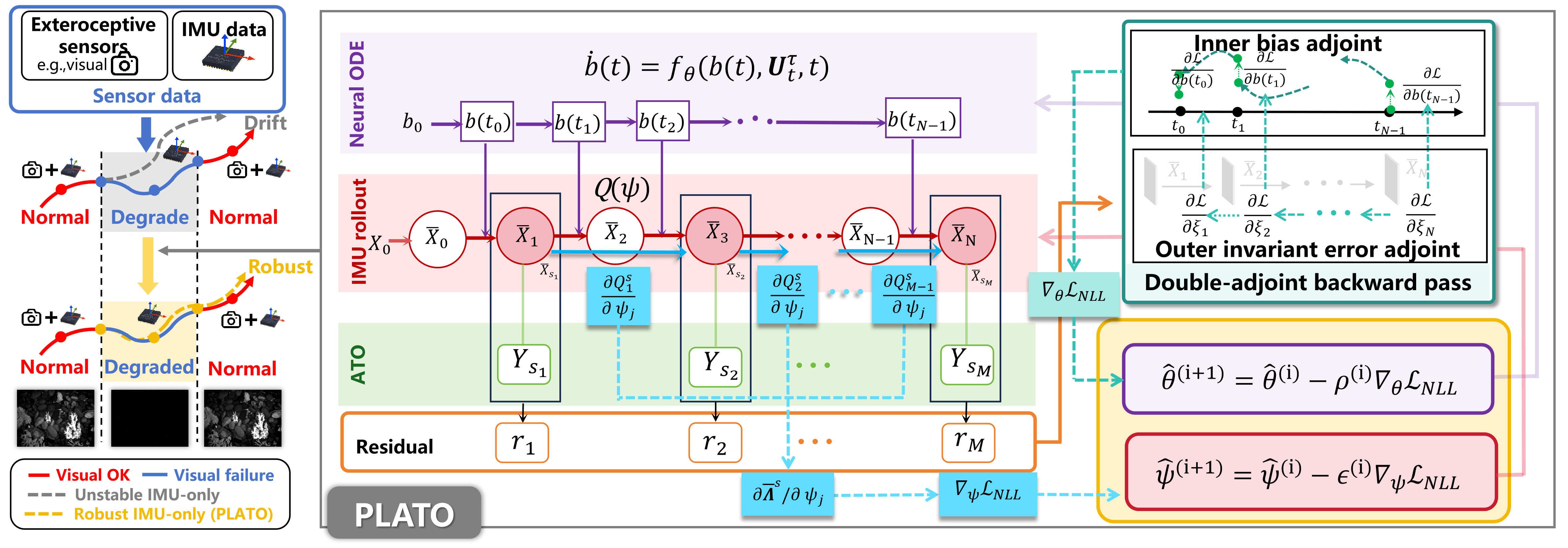
Trajectory observations
Ground-truth trajectories and noisy visual-odometry poses provide supervision through their observation models and assumed uncertainties.
1 School of Data Science, The Chinese University of Hong Kong, Shenzhen
2 School of Science and Engineering, The Chinese University of Hong Kong, Shenzhen
3 Department of Engineering Science, University of Oxford
Learn the IMU measurement model. Propagate motion through visual outages.
Neural inertial odometry has demonstrated strong potential for motion estimation in challenging environments, yet inertial-only preintegration remains sensitive to IMU bias and uncertainty. PLATO is a unified framework for jointly learning IMU bias dynamics, modeled by a neural ordinary differential equation, and gyroscope and accelerometer noise covariances.
Optimization exploits the sparse structure of the negative log-likelihood. IMU noise-parameter gradients are computed by forward differentiation, while a tailored double-adjoint scheme couples a discrete invariant-error adjoint with a continuous-time adjoint for the bias model. Experiments on EuRoC and AquaLux evaluate inertial preintegration and downstream visual-inertial odometry under intermittent visual degradation.
Trajectory observations supervise training. The learned bias model operates on IMU inputs at deployment.
Ground-truth trajectories and noisy visual-odometry poses provide supervision through their observation models and assumed uncertainties.
Jointly learn bias dynamics and IMU noise statistics by exploiting the sparse information structure of the latent inertial trajectory.
Couple an outer invariant-error adjoint with an inner continuous-time bias adjoint. Noise updates use forward covariance sensitivities.
A neural ODE models the temporal evolution of accelerometer and gyroscope biases.
Residuals are weighted by the marginal covariance .
Mean results reported in the camera-ready manuscript. Lower errors are better; protocols and supervision are shown explicitly.
| Method | Supervision | Raw integration | OpenVINS | ||
|---|---|---|---|---|---|
| AOE (°) | APE (m) | AOE (°) | APE (m) | ||
| HL-CBD | GT | 3.393 | 683.675 | 1.310 | 0.180 |
| PLATO | GT | 3.076 | 631.279 | 0.756 | 0.095 |
| PLATO | VO | 3.036 | 644.071 | 0.822 | 0.106 |
The same OpenVINS backend is used for these downstream results. The manuscript also reports LBP-InVIO as a literature reference with a different backend; it is not included in this controlled-backend summary.
| Method | Supervision | Preintegration | OpenVINS | ||
|---|---|---|---|---|---|
| Rot. RMSE (°) | Pos. RMSE (m) | Rot. RMSE (°) | Pos. RMSE (m) | ||
| Raw IMU | — | 40.828 | 3018.438 | 9.284 | 1.868 |
| HL-CBD | GT | 4.681 | 354.871 | 14.524 | 0.379 |
| PLATO | VO | 3.976 | 313.094 | 6.224 | 0.171 |
This table uses the short-horizon HL-CBD configuration. With a matched 1.6 s horizon, HL-CBD achieves 5.135° / 194.928 m and PLATO 3.976° / 313.094 m in preintegration: PLATO retains lower rotation error, while HL-CBD has lower position error. The supervision sources remain GT and VO.
The paper’s historical evaluation protocol and the current dataset preview are distinct. The preview separately flags Test_005, Test_009 and Test_011 for reference calibration quality.
| Window | Full-graph AD (MB) | Double adjoint (MB) | Memory saved | Runtime overhead |
|---|---|---|---|---|
| 16 | 525.6 | 351.3 | 33.2% | 24.2% |
| 32 | 745.5 | 366.9 | 50.8% | 5.7% |
| 64 | 1069.3 | 279.8 | 73.8% | 4.2% |
| 128 | 2067.2 | 457.0 | 77.9% | 2.3% |
The double-adjoint scheme trades additional computation for lower peak memory. In a separate long-horizon AquaLux profile on an RTX 5090 with batch size 1000, peak memory falls from 22,554.6 to 2,256 MiB.
Scope and limitations. PLATO is trained offline. The covariance model is isotropic; under noisy trajectory supervision, it acts as an effective likelihood weight rather than an independently calibrated physical sensor covariance. Cross-IMU transfer and out-of-distribution evaluation remain future work.
A controlled look at underwater visual failure. Real recordings, paired motion patterns, and the sensors to study what happens next.
Ten training sequences have generally reliable visual conditions. Ten test sequences include controlled light-off intervals, while inertial sensing and motion capture continue recording.
Both splits come from the same collection session. The split probes lighting robustness; it does not establish generalization to new sites or devices.
Choose a recording. Rotate its trajectory, inspect its lighting, and scrub through actual recorded sensor data.
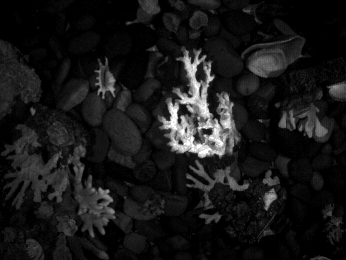
Real left-camera frames from Test_001. Light-off labels use mean brightness below 5, merge gaps up to 0.5 s, and retain intervals of at least 1 s.

AquaLux v0.1.0 · Dataset preview
Hosted on Hugging Face.
Full dataset available on Hugging Face · 20 recordings.
Original sensor recordings, reference trajectories, calibration and light-off annotations. Browse the file inventory on Hugging Face.
DATASET CARDSensor units, coordinate frames, clock conventions, splits, and annotation semantics.
Released trajectories use sensor timestamps and the IMU body frame. Apply the supplied quality masks and keep continuous segments separate. The recorded clock offset is already applied.
This is a dataset preview. Licensing and contact metadata are pending. Reference trajectories are mocap-derived candidates; physical accuracy and hardware synchronization have not been independently established. Test_005, Test_009 and Test_011 are excluded from default reference evaluation, while their raw recordings remain available.
